Evaluation & Treatment
Is a CBCT Scan Safe? Radiation and Airway Imaging Explained
Published 7 min read
CBCT Radiation: What to Know Before Your Airway Scan
You're settling into the chair for an airway evaluation, and Dr. Culotta mentions that a quick 3D CBCT scan would help her see your airway more clearly. A fair first question comes to mind: how much CBCT radiation does that involve, and is it worth worrying about?
A 3D scan sounds more serious than the flat picture your dentist has taken for years, so it makes sense to want a plain, sourced answer before you say yes.
At Austin Sleep & Airway Health, we use in-house CBCT imaging as part of many airway evaluations, and you deserve a clear answer about the radiation dose involved, not just reassurance. Here is what the research says about CBCT radiation, how we keep every scan low, and what the imaging can and cannot tell us about your airway.
How Much Radiation Does a CBCT Scan Actually Use?
A dental CBCT scan uses a fraction of the radiation of a medical CT scan, though more than a single flat dental x-ray. The American Dental Association notes that the average person in the United States already receives about 6.2 millisieverts of radiation a year from natural and everyday sources combined, and that dental imaging makes up less than 1 percent of the radiation the public receives from medical imaging overall.
CBCT radiation doses vary with how much of the jaw and airway a scan needs to capture. A peer-reviewed comparison of multiple CBCT devices found effective radiation doses ranging from roughly 19 to 368 microsieverts, with smaller, more focused scans at the lower end and wider facial views at the higher end. Airway imaging for a sleep and breathing evaluation generally uses a smaller field of view, which tends to keep the radiation dose toward the lower part of that range.
Why the ALARA Principle Guides Every Scan We Take
Every reputable imaging practice, medical or dental, follows a standard called ALARA: As Low As Reasonably Achievable. Described by the FDA and the ADA, it means an x-ray or CBCT scan is taken only when it will add information that changes or confirms a clinical decision, using the lowest radiation dose that still gives a clear enough image.
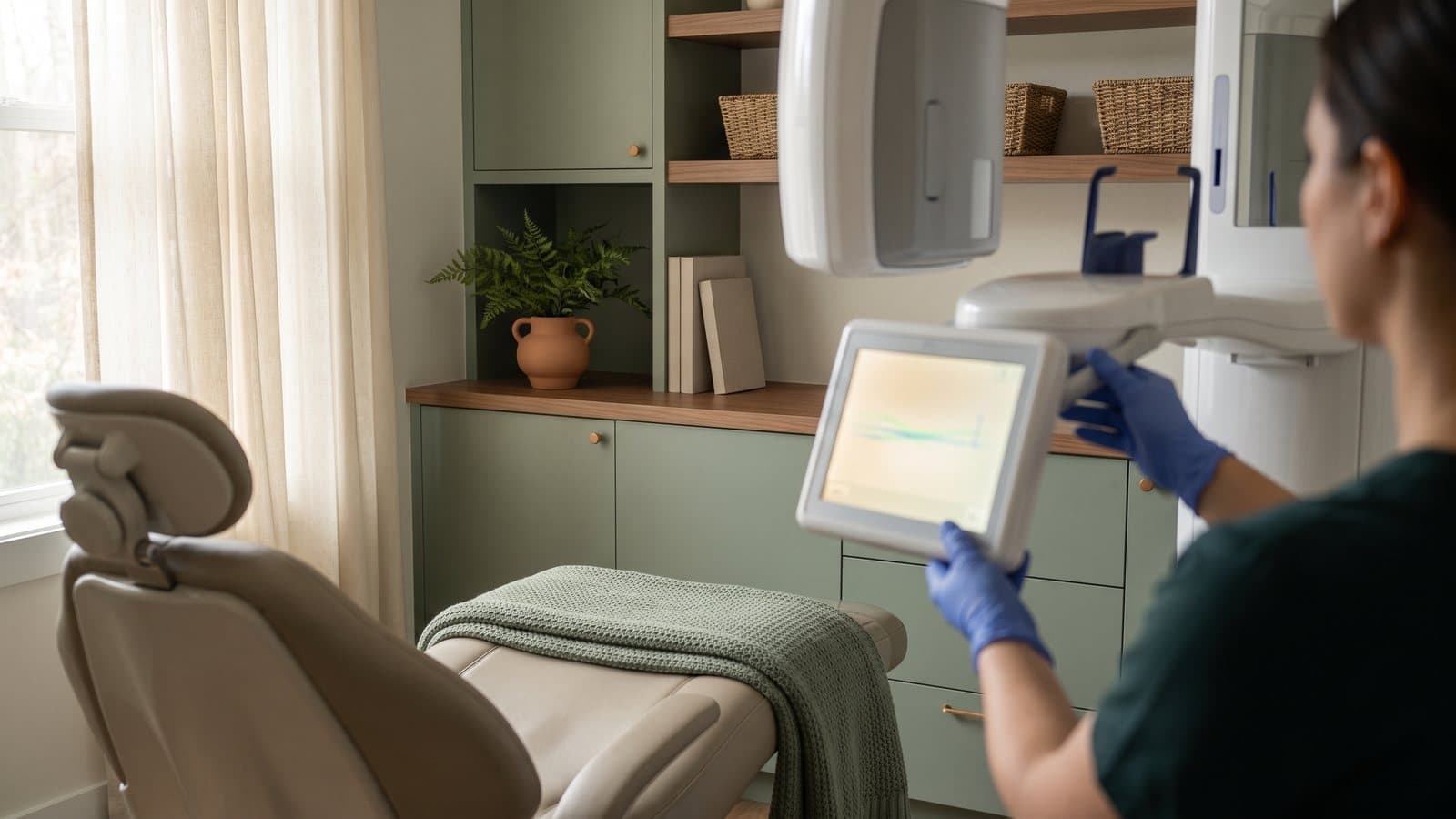
In practice, we do not scan every patient who walks through the door. We start with a conversation and an airway focused exam, and recommend a CBCT scan only when it will genuinely help Dr. Culotta understand your airway shape, volume, or structures like the tonsils, adenoids, or jaw. The scan itself takes about 45 seconds and is limited to the area we need to see.
What a CBCT Scan Shows About Your Airway
A CBCT scan is an awake, upright snapshot taken while you sit still in the chair. It is not a sleep study and cannot diagnose sleep apnea on its own. What it shows is anatomy: the shape and volume of your airway, the position of your jaw, and structures such as the tonsils, adenoids, and nasal passages that might be narrowing the space you breathe through.
Dr. Culotta uses that picture alongside a hands on airway exam and your sleep history to decide what to recommend next, whether that is a custom oral appliance, a referral to an ENT, or coordinating a home sleep test or an in-lab study with your physician. The scan adds detail; it does not replace the physician who diagnoses sleep apnea.
Is CBCT Radiation a Concern for Children and Teens?
Growing bodies are more sensitive to radiation than adult bodies, and the FDA notes children have more years ahead of them for any effect to show up, part of why pediatric imaging deserves extra care. This is one reason recent guidance the ADA published with the American Academy of Oral and Maxillofacial Radiology calls for ordering any x-ray or CBCT scan, at any age, only when there is a clear clinical reason.
For teens seen at our practice, the same ALARA approach applies: a scan is considered only after an exam and history suggest it will add useful information, with the field of view kept as small as the question allows. If you have questions about a scan recommended for your teen, ask Dr. Culotta directly what it is looking for and why.
What You Can Do Before Your CBCT Scan
You do not need to do anything special to prepare, but a few things help your visit go smoothly. Before your appointment, it helps to:
- Bring a list of recent dental or medical imaging you have had, with approximate dates, to avoid unnecessary repeat scans.
- Mention if you are or might be pregnant, so we can talk through timing with you and your physician before anything is scheduled.
- Remove earrings, glasses, and metal near your head and neck, since these can show up on the image.
- Write down what you want to know, such as which structures Dr. Culotta expects to check and how results shape your plan.
When a CBCT Airway Screening Is Worth Considering
A CBCT scan is not something every patient needs at a first visit. It tends to be worth considering when your airway focused exam and history point to something specific: snoring that concerns you or a partner, a tongue or jaw position that looks like it may be crowding your airway, or tonsils and adenoids that seem enlarged. It can also help once you are moving toward oral appliance therapy and Dr. Culotta wants to confirm how a custom device might fit your anatomy.
If you are unsure whether a scan makes sense for you, an adult sleep apnea screening or a conversation at your evaluation is a good place to start. Dr. Culotta can walk you through whether imaging would add anything useful before recommending one.
How Austin Sleep & Airway Health Approaches CBCT Radiation and Airway Imaging
At Austin Sleep & Airway Health, our in-house CBCT unit lets Dr. Culotta capture a 3D view of your airway in about 45 seconds, at a low radiation dose, without an outside imaging center. Dr. Culotta, a Diplomate of the American Board of Dental Sleep Medicine, reviews every scan personally alongside a full airway focused exam: tongue mobility and posture, palate width, bite, jaw joints, tonsil size, and nose versus mouth breathing.
We follow the ALARA principle on every scan, so imaging is recommended only when it will genuinely help guide your care, not as a routine step. When a scan points toward something worth addressing, Dr. Culotta can walk you through options such as a custom oral appliance, and she collaborates with sleep physicians, ENTs, and myofunctional therapists so the airway picture connects to the rest of your care. What to expect at your first visit is outlined on our site.
Frequently Asked Questions
How much radiation does a CBCT scan use?
A dental CBCT scan typically delivers a radiation dose somewhere between about 20 and a few hundred microsieverts, depending mostly on the size of the area being captured. Research comparing multiple CBCT devices found effective radiation doses from roughly 19 to 368 microsieverts, with smaller, more focused scans at the lower end.
Is CBCT radiation safe for children and teens?
Growing bodies are more sensitive to radiation, so any x-ray or CBCT scan for a child or teen should only be taken when there is a clear clinical reason for it. We follow that standard for every scan we recommend, and Dr. Culotta is glad to explain what a specific scan is looking for before you agree to it.
How does CBCT radiation compare to a regular dental x-ray?
A CBCT scan generally uses a higher radiation dose than a single flat dental x-ray, since it captures a full 3D volume rather than one image. Both are low dose compared with a medical CT scan, and the difference depends mostly on how much area the scan covers.
Can a CBCT scan diagnose sleep apnea?
No, a CBCT scan cannot diagnose sleep apnea on its own, since it is an awake, upright snapshot rather than a recording of how you breathe while asleep. Only a physician can diagnose sleep apnea, typically through a home sleep test or an in-lab sleep study, and Dr. Culotta can help coordinate that testing with your physician.
Is CBCT scanning safe during pregnancy?
Tell our team if you are or might be pregnant before any imaging is scheduled, since timing and necessity are decisions best made together with your physician. We can talk through whether a scan is needed now or can reasonably wait.
How often can I get a CBCT scan?
There is no fixed schedule, since the ALARA principle calls for imaging only when it will add useful information to your care, not on a routine interval. Dr. Culotta will recommend another scan only if your evaluation points to a clear clinical reason for one.
Where can I get a CBCT airway scan in Austin?
Austin Sleep & Airway Health offers in-house CBCT airway imaging at our Mueller area office in Austin, Texas, as part of a full airway evaluation with Dr. Culotta. You can schedule a consultation to find out whether a scan would add useful information to your care.
Ready to Talk Through Whether a CBCT Scan Makes Sense for You?
If you are curious about CBCT radiation or want a clearer picture of your airway, learn more about CBCT airway screenings at Austin Sleep & Airway Health, and we will walk you through whether imaging is the right next step for you.
By Austin Sleep & Airway Health
This article is for general education. It is not a diagnosis and does not replace an evaluation with a qualified provider.
See your airway in 3D
A quick, low-dose CBCT airway screening shows structural details a routine exam can miss and helps guide the next step.
Keep Reading
Related articles

Evaluation & Treatment
Sleep Study Results Explained: AHI, Oxygen, and Next Steps
Your sleep study results are in. Here is what AHI, RDI, ODI, and your oxygen numbers actually mean, and what to ask your physician about next steps.
Read more7 min read
Evaluation & Treatment
Night Guard vs. Sleep Apnea Appliance: What's the Difference?
See how a standard night guard differs from a sleep apnea appliance, what the research really says, and when an evaluation helps you choose right.
Read more7 min read
Evaluation & Treatment
Laser Snoring Treatment: What Soft Palate Tightening Involves
A calm guide to laser snoring treatment: how soft palate tightening works, what research shows, and how candidacy is decided at a consultation.
Read more7 min read
Free Sleep Apnea Quiz
Do You Have Sleep Apnea? Find Out Now
Snoring, fatigue, and restless nights could be signs of sleep apnea, a condition that affects your health more than you might realize. Take our quick, easy Sleep Apnea Quiz to uncover potential risk factors and determine if it’s time to seek expert care. In just a few minutes, you’ll gain valuable insights into your sleep health and take the first step toward better breathing, restful nights, and a healthier life. Don’t wait. Your journey to better sleep starts here!