
Kids & Teens
Restless Sleep in Kids: Tossing, Sweating, and Your Child's Positions
Published 7 min read
Sideways, Upside Down, and Soaked by Morning
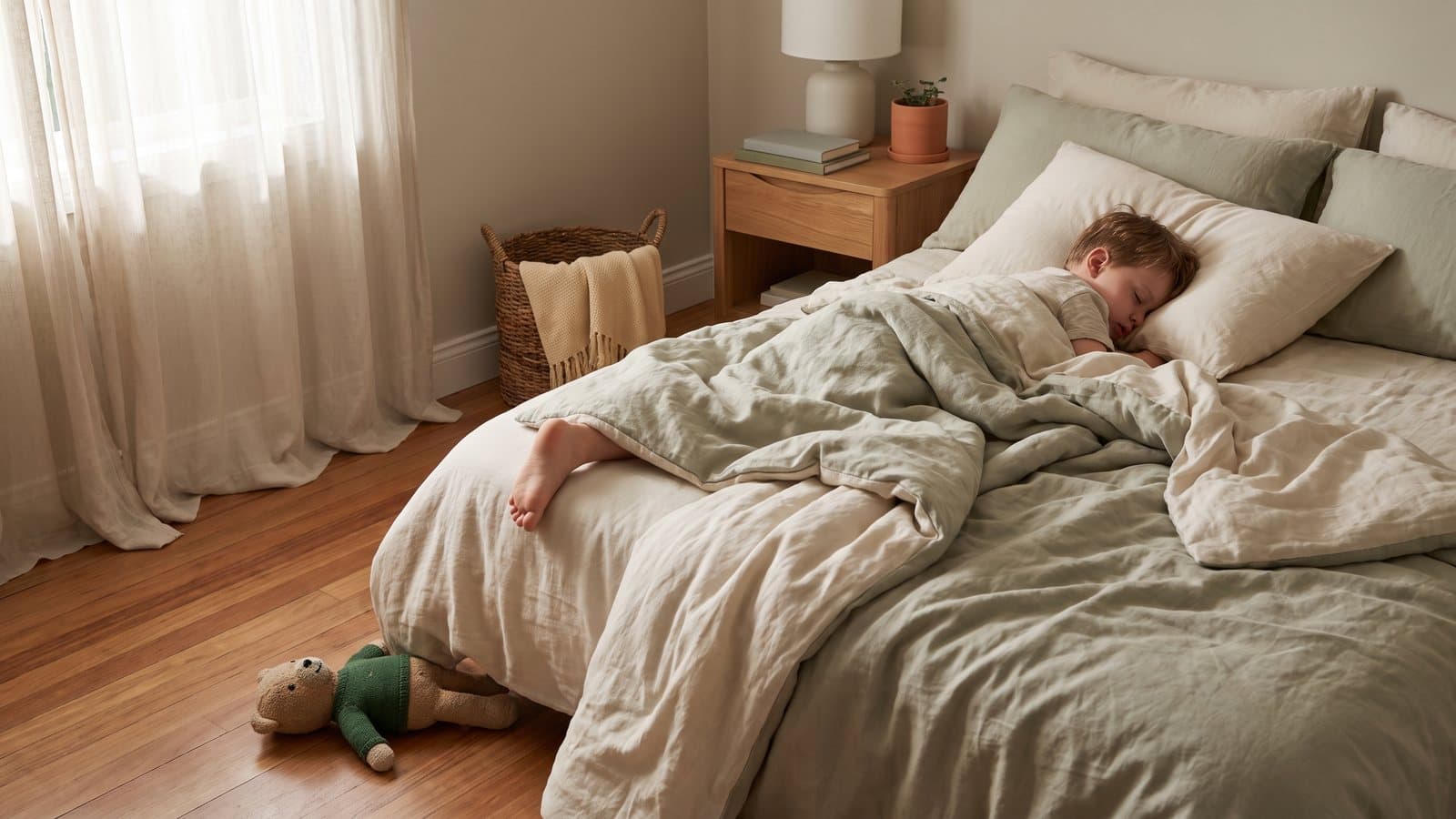
You tucked them in facing the window, blanket smooth, pillow squared. By morning they are sideways across the mattress, one leg hanging off the edge, the sheet twisted into a rope at the foot of the bed, hair damp at the temples. With the school year winding down and bedtimes getting looser by the week, you have had more chances than usual to notice it.
Child restless sleep, tossing, sweating, waking up in strange positions, is one of the most common things parents ask about, and it does not always mean something is wrong. Search any parenting forum and you will find the same question asked a dozen different ways: is my child just an active sleeper, or is something else going on.
Here, Austin Sleep & Airway Health looks at what usually drives restless sleep in kids, which positions and patterns are worth a second look, and what to track before your next visit with your child's doctor or dentist.
Is It Normal for a Child to Move So Much in Their Sleep?
Often, yes. Young children spend a larger share of the night in REM sleep than adults do, the lighter, more active stage where most tossing and repositioning happens. As kids grow, REM sleep gradually shrinks, and for many families the nightly wrestling match with the covers quiets down on its own.
Movement alone is rarely the whole story. The more useful question is whether it disrupts your child's sleep or shows up alongside snoring, mouth breathing, sweating, or trouble waking up rested. A child who tosses but wakes cheerful is a different picture than one who moves all night and still seems tired.
Why Does My Child Sweat So Much at Night?
A warm, slightly damp pillow after a full night's sleep is common in young children, whose bodies are still learning to regulate temperature, and heavy pajamas, extra blankets, or a warm room are often enough to explain it. For most families, lighter sleepwear and a cooler room settle the issue within a few nights.
Sweating that comes with restless, effortful looking sleep is a different pattern worth noting. The American Academy of Sleep Medicine's patient education materials describe sweating during sleep, along with mouth breathing and restless, frequently repositioned sleep, as signs that can appear alongside sleep disordered breathing in children. None of these signs confirm anything on their own, but together they are worth writing down.
What Your Child's Sleep Position Might Be Telling You
Neck stretched back or head turned sharply
Some children unconsciously find positions that seem to open the airway a little more. Research on sleep positions in children with obstructive sleep apnea, published in a peer reviewed pediatric journal, found these children often favored the neck stretched back or the head turned to one side, positions researchers believe may be the body working to keep air moving more easily.
Sitting up, kneeling, or draped over the edge of the bed
Sleeping propped upright, on hands and knees, or with the head hanging off the mattress can also be the body seeking a more open airway, though plenty of children land in these positions simply because they are active sleepers with nothing more going on.
A position by itself is not a diagnosis. It becomes more meaningful next to other patterns, like snoring on most nights, mouth breathing, or a child who never quite seems to wake up rested no matter how early bedtime is.
Could This Be Restless Sleep Disorder or Restless Legs?
Sleep researchers at the University of Washington have described a distinct pattern called restless sleep disorder, in which children reposition or move large muscle groups many times an hour, night after night, in ways that can leave them tired, inattentive, or short tempered the next day. Their early research found this pattern in roughly 1 in 13 children evaluated at a pediatric sleep clinic, and a related review linked it to lower iron levels in some children.
Restless legs syndrome is a related but separate possibility: an urge to move the legs, usually described by older kids and teens rather than observed directly by a parent, that can make it hard to fall asleep and shows up as kicking once asleep. Both patterns are diagnosed by a sleep specialist, not from a parent's observations alone. If restless movement is frequent and paired with daytime trouble focusing or a short fuse, it is worth raising with your pediatrician, who may check bloodwork such as ferritin.
What You Can Do Now: Keep a Two-Week Sleep Log
A log turns a vague sense that your child moves around a lot into something specific your child's doctor or Dr. Culotta can use. For about two weeks, note:
- Bedtime and position changes. Roughly how many times you notice your child repositioning, if you happen to see.
- Sound and breathing. Snoring, mouth breathing, gasps, or pauses.
- Sweating. Whether the pillow or pajamas are damp by morning, and how warm the room was.
- Mornings. Whether your child wakes easily, or seems groggy and irritable despite enough hours in bed.
- The room. Sleepwear weight, blanket layers, and room temperature, since these are the easiest variables to adjust first.
A cooler room, breathable pajamas, and a consistent wind down routine are reasonable first steps while you watch for a pattern.
When Restless Sleep in Kids Is Worth a Closer Look
Restless sleep that comes with snoring most nights, mouth breathing, gasping, or a child who wakes tired despite a full night in bed deserves a conversation with your pediatrician, who can decide whether a sleep study or a referral to an ENT or sleep physician makes sense. Only a physician diagnoses sleep apnea, and only through a sleep study.
An airway-focused dental evaluation is a good complement to that conversation, especially if restless sleep runs alongside snoring, grinding, or enlarged tonsils and adenoids, since these often travel together in kids whose growing airway has room to catch up.
How Austin Sleep & Airway Health Helps With Child Restless Sleep
Dr. Kacie Culotta, DMD, a Diplomate of the American Board of Dental Sleep Medicine, starts every visit with a detailed sleep and health history, where a two week log is genuinely useful. The airway focused exam looks at tongue mobility and resting posture, oral ties, palate width, bite, jaw joints, tonsil size, and whether your child breathes mainly through the nose or mouth, all pieces that can connect to restless, repositioned sleep.
When imaging helps complete the picture, our in-house 3D CBCT airway imaging takes about 45 seconds at a low dose and gives Dr. Culotta an awake, upright view of airway shape, volume, the tonsils, adenoids, nasal passages, and jaw position. It is not a sleep study and does not diagnose sleep apnea on its own.
From there, we coordinate with your child's pediatrician, sleep physician, ENT, and myofunctional therapists, including those in our Myofunctional Collaborative Space, so the whole picture, movement, breathing, and growth, gets looked at together. As Dr. Culotta says, "Positive change is possible at any age. Awareness is the first step."
Frequently Asked Questions
Why does my child move around so much in their sleep?
Young children spend more of the night in lighter, active REM sleep than adults do, which is when most tossing and repositioning happens. Movement alone is usually just development, and it becomes more worth noting when it comes with snoring, sweating, or a child who wakes up tired.
Is restless sleep in kids a sign of sleep apnea?
Restless sleep can be one piece of the picture, but it is not proof of sleep apnea on its own. Only a physician can diagnose sleep apnea, through a sleep study, so restless sleep alongside snoring or mouth breathing is worth a conversation with your pediatrician.
Why does my child sleep with their head tipped back or neck stretched out?
Some children land in this position simply because they move a lot in sleep, while others may be unconsciously adjusting to breathe more easily. Research on sleep positions in kids with breathing related sleep problems has linked a stretched back neck to airway obstruction, so it is worth mentioning if it happens most nights.
Could low iron be causing my child's restless sleep?
Some research on restless sleep disorder has linked frequent, large nighttime movements to lower iron levels in certain children. This is something only a physician can evaluate through bloodwork, so it is worth raising rather than guessing at home.
Should I wake my child up when they are tossing and turning?
There is usually no need to wake your child for ordinary tossing and turning, since interrupting sleep does more harm than the movement itself. Instead, note what you notice and bring those details to your next appointment.
Where can I get my child's restless sleep evaluated in Austin?
Austin Sleep & Airway Health offers airway focused evaluations for children at 1701 Simond Ave, Suite 107A, in Austin's Mueller area. Call (512) 900-9715 to schedule, and we are glad to coordinate with your child's pediatrician or sleep physician.
A Calm Next Step as the School Year Winds Down
If your evenings have turned into a nightly search for the blanket and a search for answers, our educational sleep screening for ages 2 to 5 is a simple place to start organizing what you have noticed. It does not confirm or rule out anything, and when you are ready, our team is here to take a closer look at how your child sleeps, moves, and breathes.
By Austin Sleep & Airway Health
This article is for general education. It is not a diagnosis and does not replace an evaluation with a qualified provider.
Noticing something about your little one's sleep?
Our educational screening for children ages 2 to 5 helps you sort out which night signs are worth mentioning at an evaluation.
Keep Reading
Related articles
Kids & Teens
Why Is My Teenager Always Tired?
If your teenager is always tired despite sleeping in on weekends, here is what is typical teen sleep biology and when airway signs deserve a look.
Read more7 min read
Kids & Teens
Thumb Sucking and Teeth: What Summer Break Reveals
Thumb sucking and teeth: how a habit that lingers past toddler years can shape a child's bite and breathing, plus what to try this summer break.
Read more7 min read
Kids & Teens
Bedwetting and Sleep Apnea: Could Breathing Be a Factor?
Bedwetting and sleep apnea can be connected in some children. Learn common causes, how breathing may factor in, and when a closer look helps.
Read more7 min read