Sleep Apnea & Snoring
Still Tired After Daylight Saving Time? A Two-Week Sleep Check
Published 7 min read
The Extra Hour That Didn't Feel Like One
Early Sunday, Nov. 2, the clocks fell back, and you were promised an extra hour. Now it's Tuesday. You woke before your alarm anyway, it was dark on the drive home, and by midafternoon your focus is gone.
If your daylight saving time sleep feels off, you're in good company. A one-hour shift sounds small, but your body keeps its own schedule, and it doesn't reset just because your phone did.
At Austin Sleep & Airway Health, we look at sleep through breathing and the airway, so the time change makes a useful checkpoint. This post covers why falling back leaves you tired, how long adjusting takes, and the signs worth a closer look.
Why Am I So Tired After Gaining an Hour?
The short answer: your wall clock moved, but your body clock did not. Your internal rhythm takes its cues mostly from light, and for a few days it keeps running on the old schedule.
Your body wakes with the sun
After the change, sunrise arrives an hour earlier by the clock. Mass General Brigham sleep specialists note this can wake people before they meant to get up, erasing the extra hour. Opening your eyes at 5 a.m. instead of 6 is a common pattern.
Early risers often feel it most
A UCSF expert on body clocks explains that falling back is easier on night owls and harder on morning larks, already primed to wake early. Going into the weekend short on sleep can make it worse.
Darker evenings change your routine
Evenings now get dark about an hour sooner. That often means less time outside, dozing on the couch after dinner, and a bedtime that drifts, just a routine in transition.
How Long Does It Take to Adjust to the Fall Time Change?
For most adults, not long. The CDC's National Institute for Occupational Safety and Health notes it can take about one week for the body to adjust to new times for sleeping, eating, and activity. The American Academy of Sleep Medicine (AASM) adds that standard time lines up best with human circadian biology, since it helps sync the body clock with sunrise and sunset. The switch, not the destination, is the problem.
Texas lawmakers passed a bill in 2025 to keep the state on daylight saving time year-round if Congress allows it, so Austin's clocks still change twice a year for now. That gives you a checkpoint: still dragging two weeks out is a sign the clock isn't the whole story.
Daylight Saving Time Sleep Tips for This Week
Small, steady cues help your body catch up, no special products needed.
Get outside in the morning
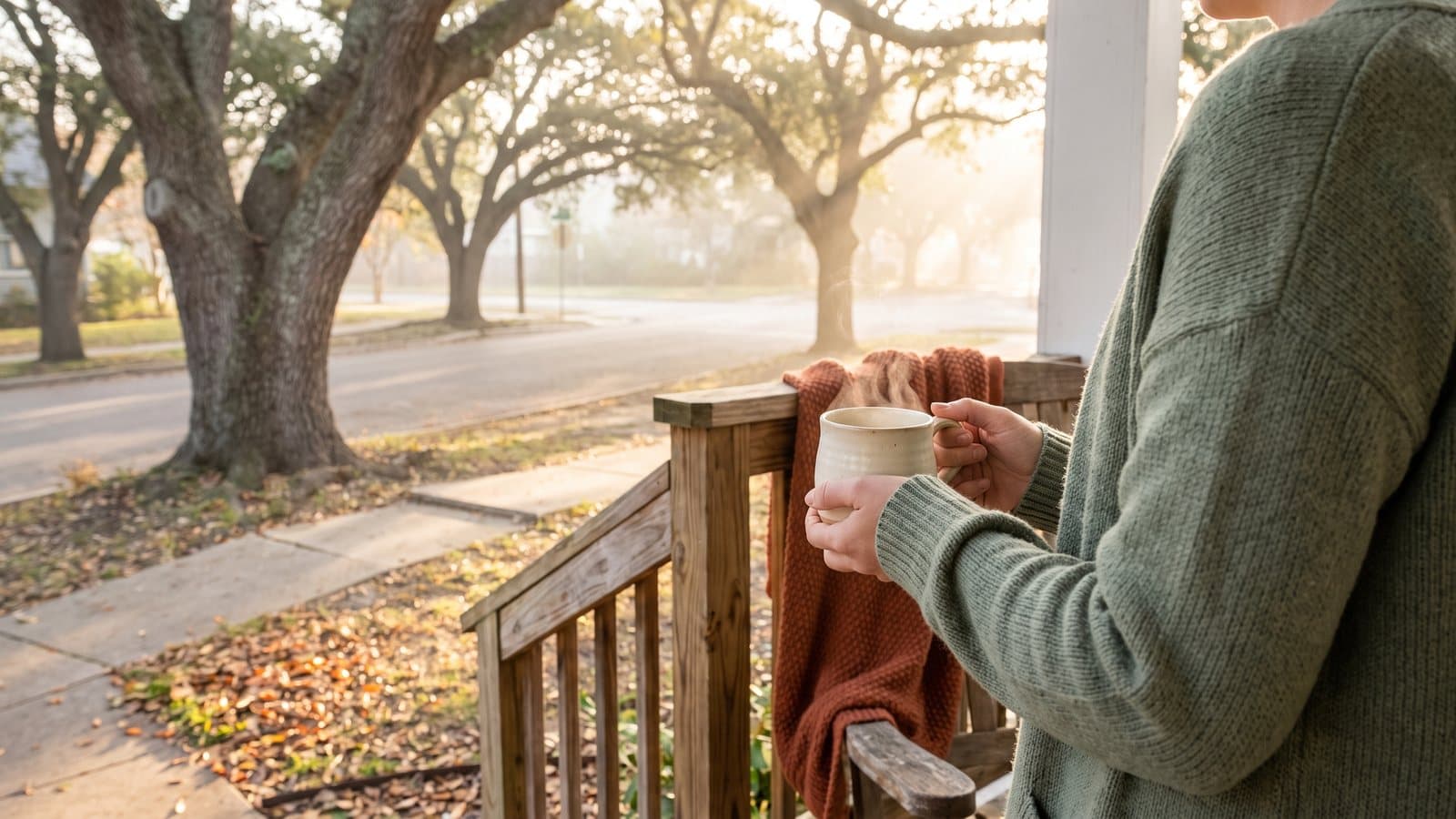
Step outside soon after waking, even for a few minutes with your coffee. Morning daylight is one of the strongest signals your body clock uses to set the day's timing.
Keep your wake time steady
Pick a wake time and hold it, weekends included. Sleeping in on Saturday can pull your rhythm back toward the old schedule. If you're waking too early, blackout curtains or a sleep mask can help.
Move dinner, caffeine, and screens earlier
Experts at Mass General Brigham suggest an earlier dinner and keeping caffeine to the morning or early afternoon. Dimming lights and setting screens aside before bed gives your body a clearer signal the day is ending.
Keep naps short and early
The late-afternoon slump is real this week. Keep any rest brief and well before evening so it doesn't push bedtime later.
Your Two-Week Sleep Check: What to Track
While your body adjusts, a few notes each morning can show whether things are settling. Jot down:
- Bedtime and wake time, and roughly how long you slept.
- How rested you felt on waking, on a simple 1 to 5 scale.
- Whether you snored, or had pauses, gasps, or choking sounds a partner noticed.
- Morning dry mouth, headaches, or a sore, tired jaw.
- How often you woke up, including trips to the bathroom.
- Afternoon energy and focus.
NHLBI notes a sleep diary like this can help your provider understand how long and well you sleep and how sleepy you feel during the day. If you wear a smartwatch, its data can add to the picture, and our guide on what to do after a smartwatch sleep apnea alert explains how to use it without over-reading it.
Clock Tired or Something Else? Signs That Outlast the Time Change
By the second week, most time-change tiredness has faded. If yours hasn't, ask what kind of tired it is.
You're getting enough hours but still wake unrefreshed
The CDC recommends seven or more hours nightly for most adults and lists feeling tired despite enough sleep as one sign your sleep deserves attention. If Sunday's bonus hour and a steady week made no dent, that's worth noticing.
Your nights include snoring or pauses
According to NHLBI, signs of sleep apnea include loud snoring, breathing that stops and starts, gasping, dry mouth, headaches, and waking often to urinate. Many people don't know until someone tells them. Our guide to how snoring differs from sleep apnea can help you make sense of what a partner hears.
Shorter days are affecting your mood
NIMH notes a winter pattern of seasonal mood changes often begins in late fall, with signs such as oversleeping, low energy, and pulling away from activities. If darker evenings weigh on you more than usual, raise it with a provider too.
When Lingering Tiredness Is Worth an Evaluation
Two weeks after the change, it's worth a closer look if you're sleeping seven or more hours and still waking unrefreshed, if someone hears you snore or notices pauses or gasping, or if dry mouth, headaches, or bathroom trips keep showing up in your notes, along with daytime drowsiness that disrupts work or driving.
These signs are not a diagnosis. Only a physician can diagnose sleep apnea, through a home sleep test or an in-lab sleep study, and our comparison of home sleep tests and in-lab studies explains how each works. Bring your two-week notes; they turn vague tiredness into something specific.
How Austin Sleep & Airway Health Helps When Tiredness Lingers
Dr. Culotta is a Diplomate of the American Board of Dental Sleep Medicine and a Qualified Dentist with the American Academy of Dental Sleep Medicine. When tiredness outlasts the time change, she looks at how you breathe, starting with your airway.
Our in-house 3D CBCT airway imaging takes about 45 seconds and uses a low dose. Dr. Culotta reviews airway shape and volume, plus the tonsils, adenoids, nasal passages, and jaw position. It's an awake, upright snapshot, so it doesn't diagnose sleep apnea, but it can show where space looks tight.
The airway-focused exam adds tongue mobility and posture, oral ties, palate width, bite, jaw joints, tonsil size, mouth breathing, and signs of clenching, plus a detailed sleep history. Your two-week notes fit right in.
From there, we connect the dots: coordinating a sleep study, looping in an ENT when needed, and working alongside therapists in our Myofunctional Collaborative Space. If a physician confirms sleep apnea, a custom oral appliance is one option alongside CPAP, and some people use both.
Frequently Asked Questions
Why am I more tired after gaining an hour of sleep?
The extra hour often disappears because your body clock still runs on the old schedule, so you may wake early and sleep less overall. Morning daylight and a steady wake time help your rhythm catch up.
How long does it take to adjust to the time change?
Most adults adjust within about a week, matching CDC NIOSH guidance on clock changes. Early risers and people already short on sleep may need a little longer.
Why do I keep waking up an hour early since the clocks changed?
Sunrise now comes an hour earlier by the clock, and a body used to waking with the light may keep doing so for days. Blackout curtains and a consistent bedtime can help you settle in.
Can the time change make sleep apnea worse?
The one-hour clock change isn't known to cause sleep apnea, but a week of choppier sleep can make existing tiredness harder to ignore. If you already use CPAP or an oral appliance, keep using it through the transition and mention lingering changes to your physician.
Is tiredness after the clocks change a sign of seasonal depression?
Not usually, since most time-change tiredness fades within about a week, but low mood and energy that linger as days shorten are worth raising with a provider. NIMH notes winter-pattern seasonal changes often begin in late fall.
Where can I get help for tiredness and snoring in Austin?
Austin Sleep & Airway Health offers airway evaluations with in-house 3D CBCT imaging at 1701 Simond Ave, Suite 107A, in Austin's Mueller area. Call (512) 900-9715 or email hello@austinsleephealth.com. We're open Monday, Tuesday, Thursday, and Friday, 8:00 AM to 3:00 PM.
Give Your Body Two Weeks, Then Get Curious
If mid-November arrives and you're still dragging, you've already done the hard part by noticing. Our adult sleep apnea screening is a short, educational set of questions that helps you organize what you've tracked. It can't confirm or rule anything out, but it's a calm first step toward a conversation with Dr. Culotta or your physician. As Dr. Culotta puts it, "It's never too late to breathe, sleep, and feel better."
By Austin Sleep & Airway Health
This article is for general education. It is not a diagnosis and does not replace an evaluation with a qualified provider.
Wondering whether a sleep evaluation is right for you?
Take our quick, educational adult sleep screening to better understand your risk factors and what to bring to a visit.
Keep Reading
Related articles

Sleep Apnea & Snoring
Acid Reflux at Night and Sleep Apnea: How They Connect
Acid reflux and sleep apnea often overlap at night. Here is what research says about the connection, what to notice, and when to get it checked.
Read more7 min read
Sleep Apnea & Snoring
Waking Up to Pee at Night: A Sleep Apnea Connection?
Waking up to pee at night more than once? It could be summer hydration, or your airway. Here is what is normal and worth mentioning at a visit.
Read more7 min read
Sleep Apnea & Snoring
Waking Up With a Headache? What It Could Mean
Waking up with a headache in Austin's summer heat? See how dehydration, jaw clenching, and sleep apnea can each play a role, and what to track.
Read more7 min read